

 By jmb
I decide to write this blog post partly as a message to my future self (so I can remember what this moment was like), but also because I know others are feeling this tension, but might be nervous to express how they are feeling.
I was born in June 1976, only a month before the US Bicentennial, so I was brought up in a patriotic world. And I grew up in Oklahoma, in a context that was saturated in patriotic ideology. But today at age 50, I sadly see things very differently and in some ways I’m grieving this change.
I think it is time to unpack why I’m feeling grief at this moment.
A Patriotic Childhood
I grew up (from age 5 onwards) in Newcastle, Oklahoma. In those days, it was a rural community, which only a few years before went through a population boom which was fueled by paranoid white people fleeing court-ordered public-school desegregation in Oklahoma City. To give an insight into the demographics of Newcastle, the population in 1990 (my Freshman year) of my town was 92% white, with the remainder being mostly Native Americans and Hispanics. — I recall having only two classmates who were African-American (one kid in 1st grade whose family moved the next year, and one mixed race Black teen in the latter years of high school).
Religiously and politically the town was very conservative, with the dominant church being Baptist. Catholics were quite rare, and being publicly out as an atheist was unheard of (almost as unheard of as being out as LGBT+).
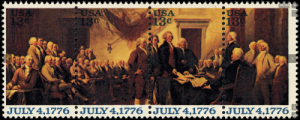
 Also, I should mention that I was born in 1976, the year of the Bicentennial , and I collected both stamps and coins, so I of course tried to collect all of the special Bicentennial issues of coinage and postage stamps, as well as some of the other kitschy memorabilia from that time that was still commonly seen in garage sales for the following two decades. I was very proud that I was born on that year, even dreaming that if I lived to be 100, that I would get to be there for the Tricentennial.
We of course said the pledge of allegiance at the start of our Elementary school days, but flag ceremonies were also common at most sporting events, civic gatherings and even some churches. I remember visiting the First Baptist Church’s Vacation Bible School which had us say the pledge of allegiance every morning — but also my Church of Church summer camp had us saying the pledge every morning. 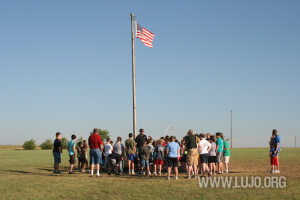 And since I was in both the Marching Band and in Scouting, flag ceremonies were an important part of my life. We were taught to treat the flag with deep respect (never to joke about it, never to let it touch the ground, etc.), seeing it as a symbol of “our great nation.” And this message was hammered home through events at my school and in the community.
There were other flags in my life. There was of course the Oklahoma flag (which I still love, with its many symbols of peace) and of course the Boy Scout unit flags, but I also remember the Confederate flag being frequently present — not in official capacities like school events, but rather on bumper stickers, flying from the backs of pickup trucks and sometimes even on home flag poles. I don’t recall it being talked about much, except that I remember hearing the flag represented “southern pride” and the defense of State’s Rights. And so, I believed what I was told.
Looking back on it now, I think I was duped thanks to my sub-par education about the US Civil War,[1] my family heritage (I have multiple Confederate veteran ancestors, as well as some who fought for the North), but mostly because “state’s rights” was a popular idea culturally in this town of 92% white people. We often heard it at the barber shop, sitting in the bleachers, talking after church – everywhere we heard about increasing “federal intrusions into our lives,” which tapped into the State’s Rights myth.
Waking Up
I started questioning patriotism during my college years. The first seed of doubt was planted by a Church of Christ minister from Honduras who I worked with at a church camp. He asked us, “why are we saying a pledge of allegiance every morning? Isn’t this excluding your brothers and sisters in Christ who aren’t US citizens?” But I had more seeds of doubt planted through reading 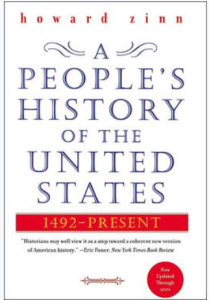 Howard Zinn’s The People’s History of the United States, but the final nail in the coffin of my nationalism was a religious awakening that came from re-reading the Bible’s Four Gospel accounts (Matthew, Mark, Luke and John) with fresh eyes. This eventually made me question the morality of war, capitalism, and nationalism, as these things directly conflicted with the teachings of Jesus, especially in his Sermon on the Mount.
And thankfully, it was during these years that I finally woke up to what the Confederate flag was really about: anti-Black hatred and slavery. I also had to acknowledge that even if one displayed the flag with the supposed “good” intent of supporting State’s Rights, that this intent didn’t change how one’s neighbors would see the flag, as a symbol of ignorance at best, but more likely hatred.
I continued to grapple with these issues for several years, but eventually I realized that patriotism and nationalism were forms of idolatry, and that nationalism directly fueled hatred and violence. And so, I went the other direction, eventually finding my way to the progressive/radical wing of the Mennonite Church when I was in law school. It was during these years that I quit saying the pledge of allegiance. I also started affirming oaths (rather than swearing them), seeing these practices as ways to symbolically make clear, at least to myself, that my ultimate loyalty would never be to the nation-state.
The Question of National Civic Values
Despite my symbolic Mennonite gestures of disconnecting from the Empire, I also had to admit that I was still enmeshed in this system, partly because I was a lawyer (an “officer of the court,” meaning that I’m literally a part of third branch of government), but also because I was an activist who was seeking to bring reforms to the world. This meant that unless I changed my career and went “off the grid” politically, I would always be part of the system.
And later, when I converted to Judaism,[2]I came to grapple with other questions including: (1) how can I be loyal to the trans-national peoplehood of “Israel” without backing a nation-state called “Israel” whose policies towards the Palestinian people were cruel and inhumane (which felt like yet another form of toxic nationalism), and (2) are certain US American values (like democracy, due process of law, etc.) actually Jewish values, and as such should these values lead me to rethink my views on patriotism?
I’m still sorting out the first of those questions,[3] but on the second question, I will say that the emphasis on positive civic engagement common in liberal forms of Judaism began to influence me, enough that I started to reconsider some of my previous iron-clad resolutions (i.e. I no longer objected to the “prayer for our nation” being a part of the service since it was aspirational in nature, rather than being overtly nationalistic). I also found other ways to speak and act more clearly in defense of US American institutions and values, including by working for the US Census Bureau in 2020 during the COVID pandemic.
At the same time, my feelings about patriotic symbols have not changed. I still can’ t look at the US flag without seeing it through the eyes of immigrants who are being hunted down like animals by ICE, or through the eyes of the Cuban people who are being starved by US sanctions, or through the eyes of the people of Gaza who know that the bombs dropped on their homes may have been dropped by the state of Israel, but that those weapons came from the USA. And it still bothers me that so many religious communities place this flag in their buildings, which feels like capitulation to idolatry. And it deeply troubles me that we are still worshipping the flag through flag salutes in school, sending the message to vulnerable children that worship of the state is our highest value.
USA250 — a time for mourning and Teshuvah, not celebration
The Fourth of July holiday is coming in just a few days, and it feels like this should be a time of collective mourning and reflection, in the hopes that it can lead us to Teshuvah.
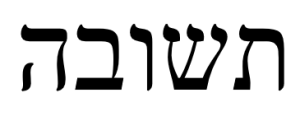 Teshuvah is a Hebrew word which is often translated as “repentance.” It requires recognition and acknowledgment that one has done wrong, earnest efforts at making amends, and a commitment to not doing harm again. Teshuvah might begin with remorse and grief, but it always moves to the hope of restored relationships and the amelioration of harms. It is a practice that leads to hope.
I began this post by thinking about my future self, so I’m going to conclude in the same way. I want my future self to know that today I feel very uncertain about the future of this nation. I worry that our most cherished values and norms are dissolving and that the rise of fascism in this nation under Trump may have reached the point of no return. At the same time, I also believe in the power of humanity to change and the power of Teshuvah to heal. Despite my occasional desire to emigrate and be done with it, I haven’t yet given up hope. My hope is that our nation and its people can still do the hard work of Teshuvah, and that we all can take our own individual steps on this journey.
And one final thought, this holiday can also serve as a reminder of the limited nature of our perspective. The United States of America may or may not survive another 50 years, but there are many other nations in this world. For too long, we in the US have assumed that the world hinges on our nation surviving and thriving, but in reality, our ties to collective humanity transcend national boundary lines (even when despots build walls). Maybe we need to flip the idea of 4th of July as “Independence Day” on its head, remembering that maybe we need to declare our independence from nationalism itself?
[1] This was a hard sentence to write, because one of my favorite teachers taught two of my years of high school history. I now know that he was wrong about the Civil War (most notably his incorrect statistics on the number of white people who were enslavers, but also his insistence that slavery was not the primary reason for the war), while at the same being very accurate and profound at other points in his teaching of US history.
[2] The story of my conversion to Judaism is another complicated and long story. Here is what I wrote back in 2014 about my decision to do this. I will only add for my Christian readers, that I still deeply value the ethical teachings of Jesus, even though I no longer see him as part of a trinitarian conception of God.
[3] Today I tend to describe myself as a Non-Zionist or a Diasporast, but I will have to write about that subject on another occasion.