

 By jmb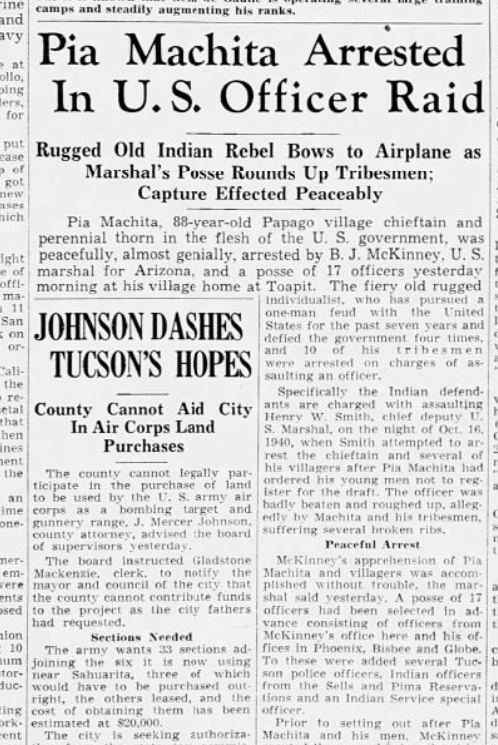
I wrote this paper for a class I’ve taken this semester at Tohono O’odham Community College, but I decided to improve it a bit and republish it here on my blog.
The Rebellion of Pia Machita
By James M. Branum
Adapted from a paper written for the class
Tohono O’odham History and Culture
Tohono O’odham Community College – Spring 2026
All views expressed in this paper are the author’s and do not necessarily represent the views of anyone else.
The recent talk by Trump administration officials that a U.S. military draft not being “off of the table,”[1] (in the context of the war with Iran) has awakened fears of the reinstatement of a draft.
For Indigenous Americans, it may be worth considering the different responses taken by Indigenous people in the past, including not only the many who chose to enlist and/or be drafted, but also those who chose to resist conscription, whose stories are often not told. It is for this reason that I’ve decided to explore the story of Pia Machita,[2] a Tohono O’odham[3] elder who engaged in a tremendous action of resistance against the US federal government and its war machine.[4]
The story of Pia Machita
The historical record tells us very little about Pia Machita’s early years. We first hear of him in the written historical narrative beginning in the 1930s, when he was already aged, probably in his 70s or 80s. He was the head man at the village of Stoa Pitk (in some sources, called Toapit) [5] in the Hickwan district,[6] a position that might best be understood as a combination of a lead elder and a village mayor. But these analogies are less than precise, because the O’odham way of governance was quite different from white society, because the Headman normally led not by coercion or threats, but rather through influence.[7]
Machita’s first recorded act of rebellion occurred in 1935, when he told US government officials that his village would not allow cattle inspectors to check his villagers for tuberculosis.[8] His argument in support of this and his later actions was based on his belief that the Gadsden Purchase (in which Mexico ceded parts of modern-day Arizona and New Mexico to the United States) was invalid, because the O’odham people were not consulted, and hence the laws of the United States were invalid.[9] And he amplified his point by flying a Mexican flag over his house (the de facto headquarters of his village)[10] as a symbol of his belief that the land was under Mexican jurisdiction.[11]
The second point of conflict between Pia Machita and the US government came from the US Census. He again refused to allow census takers to come into his village, which resulted in significant conflict and negotiations.[12] But this rebellion (like the previous one) was not widely discussed in the media at the time and only came to light later.
The final conflict came in 1940, thanks to the reinstatement of military conscription (aka “the draft”) by the US, which President Franklin D. Roosevelt signed into law on September 16, 1940.[13] Machita began speaking out against the draft and told the young men of the village that they should not register because they were not subject to US jurisdiction.[14] News of this reached the authorities, who ordered that Pia Machita be arrested; however, when an attempt to go to the village to arrest Machita was made on October 16, 1940, they were met with physical force,[15] which resulted in one of the officers suffering several broken ribs.
At first, it appeared that the authorities might choose to ignore Machita’s rebellion; however, growing concerns about a possible Japanese invasion of the Southwest United States from Mexico (and the concern that indigenous people might support such an invasion),[16] as well as growing unrest nationwide about military conscription led the authorities to take a more drastic approach. Also, local officials fueled the paranoia by requesting access to grenades, a machine gun, gas bombs, and an airplane from nearby Fort Huachuca to flush out Pia Machita and his men.[17]
The final push to arrest Machita came months later, in May 1941.[18] Instead of a military plane, law enforcement (a mix of federal, local, and tribal officers[19]) made use of a chartered airplane, which signaled to the law enforcement officers on the ground where Machita’s men were located. The arrest itself happened peaceably, with Machita being allowed to finish his breakfast and milk his cow before being taken away.[20]
The Arizona Daily Star provided a gripping account of the arrest, so I will share the opening paragraph of the story:
Pia Machita Arrested in U.S. Officer Raid
Rugged Old Indian Rebel Bows to Airplane as Marshal’s Posse Rounds Up Tribesmen; Capture Effected Peaceably
Pia Machita, 88-year-old Papago village chieftain and perennial thorn in the flesh of the U. S. government, was peacefully, almost genially, arrested by B. J. McKinney, U. S. marshal for Arizona, and a posse of 17 officers yesterday morning at his village home at Toapit. The fiery old rugged individualist, who has pursued a one-man feud with the United States for the past seven years and defied the government four times, and 10 of his tribesmen were arrested on charges of assaulting an officer.[21]
Initially, eleven of Machita’s men were indicted,[22] but only three (his brother-in-law, Leandro Ortega, age 77, and Jose Lewis, age 54).[23] were convicted, not of resisting the draft but of charges related to the assault on the law enforcement officer who was beaten during the first attempt to capture Machita. Machita received a sentence of 18 months in prison, while his two associates were each sentenced to 16 months in prison.[24]
Interestingly, throughout the saga, the response by the public was generally supportive of Pia Machita, as shown by supportive newspaper editorials[25] and even a letter to the editor to a Tucson newspaper.[26]
Machita’s incarceration went relatively well, despite him being shipped between several different facilities (part of the time he spent as the warden’s gardener).[27] The experience of seeing the outside world changed him, including leading him to change his position on education, sending word back to his village that the youth should go to school.[28]
As for the young men of Stoa Pitk village, many ended up being found to be exempt from the draft due to a lack of literacy. And upon release, Machita lived the rest of his life quietly (as far as we know), and he lived until approximately age 100, but again the details of this are scarce.[29]
Looking Back at the Machita Rebellion
While I realize that many may see Machita’s rebellion as naïve, foolish, and stubborn, or maybe just a matter of “rugged individuality” as the Arizona Daily Star described it,[30] I think a better approach is to understand Machita’s action as being one of rebellion against tyranny, namely the absurd idea that the O’odham people owed any allegiance to the occupying nation that had dominated them. While many might critique Machita’s method of resistance (including the use of physical violence to resist), I think it is better to understand Machita’s stand through the historical understanding of the long history of Indigenous resistance to colonialism and militarism.
Pia Machita was not the first Indigenous person to resist military conscription. Here in Oklahoma (where I was born and now live), we have a memory of the Green Corn Rebellion,[31] a tri-racial coalition of poor White, Black, and Indigenous (primarily Seminole and Muscogee Creek) people who engaged in an armed rebellion in August 1917 in opposition to the newly created draft in World War I, but also in support of a broader vision of socialism, informed by indigenous and rural values. This rebellion was brutally crushed, with many of the organizers being sent to federal prison, but the memory of the rebellion lives on. Oklahoma activists (including myself) have drawn inspiration from this action and the courage of those who dared to dream of a better world.
This idea of remembrance is critical in considering the impact of the Machita Rebellion. While the following quote was told about the Green Corn Rebellion, many of the ideas could equally be applied to how we might choose to remember Machita’s Rebellion.
The full moon of late July, early August it was, the Moon of the Green Corn. It was not easy to persuade our poor white and black brothers and sisters to rise up. We told them that rising up, standing up, whatever the consequences, would inspire future generations. Our courage, our bravery would be remembered and copied. That has been the Indian way for centuries, since the invasions. Fight and tell the story so that those who come after or their descendants will rise up once again. It may take a thousand years, but that is how we continue and eventually prevail.[32]
This is why I think Pia Machita’s story needs to be told, considered, and even celebrated.
BIBLIOGRPAHY
Arman, Donald L.P. World War II: The Exodus Indiana Univ. Press 1994, p. 111-112. https://www.jstor.org/stable/jj.32688746.12.
Bernstein, Alison R. American Indians and World War II: Toward a new era in Indian affairs. Norman: University of Oklahoma Press, 1999. 27-28.
Carrol, Al “‘Savages Again’:” Medicine Bags and Dog Tags, 2008, 114–34. https://doi.org/10.2307/j.ctt1dfnv0s.10.
Erickson, Winston P. Sharing the desert: The tohono o’odham in history. University of Arizona Press, 1994.
Flaccus, Elmer (1981). “Arizona’s Last Great Indian War: The Saga of Pia Machita”. The Journal of Arizona History. 22.
“Green Corn Rebellion” Wikipedia https://en.wikipedia.org/wiki/Green_Corn_Rebellion
Hasbrouck, Edward “Even if team Trump wanted it, a military draft would be a fiasco” Responsible Statecraft (Mar 10, 2026) https://responsiblestatecraft.org/military-draft-iran/
Hayden, Julian D. Field man: Life as a desert archaeologist. The Univ of Arizona Press, 2016.
Hendricks, J. D. “Resistance and Collaboration: O’odham Responses to U.S. Invasion” Tiamat Publications, no. 5 (2004): 16–17. https://www.yumpu.com/en/document/view/29836152/resistance-and-collaboration-oodham-responses-to-us-invasion
Henry, Bonnie “Arizona’s Last Indian War: O’odham village chief opposed letting his men register for the draft in 1940” Arizona Daily Star (August 22, 1993) https://tucson.newspapers.com/image/166183186/
“In Behalf of Pia Machita” Tucson Daily Citizen (July 24, 1941) https://tucson.newspapers.com/image/581345923/
Ingram, Helen, Nancy K. Laney, and David M. Gillian Divided Waters: Bridging the U.S.-Mexico Border Univ. of Arizona Press 1995, p. 30. https://www.jstor.org/stable/j.ctt1h1hwt2.7
Jennings, Matthew. 2017. “Native Americans in World War II and the Forties.” The Native Americans, Second Edition. Facts on File. https://online.infobase.com/Auth/Index?aid=9413&itemid=WE43&articleId=406425
Kalil, Dorothy “Proud Chief Defied Federal Government Nine Years Ago” (Feb. 23, 1950) Tucson Citizen https://tucson.newspapers.com/image/582530795/
“Legacy of Rebellion: Saga of Pia Machita impedes Pagao attempts to take census to divide $26 million” Arizona Daily Star (Section D, page 1), May 8, 1977 https://tucson.newspapers.com/image/163552102/
“Machita Incident” Wikipedia online at: https://en.wikipedia.org/wiki/Machita_incident
Melton, Brad, and Dean Smith. Arizona goes to war: The Home Front and the front lines during World War II. Tucson: University of Arizona Press, 2003. 75-78. (available online at: https://books.google.co.nz/books?hl=en&lr=&id=-_C-KOJc8XAC&oi=fnd&pg=PR9&dq=Pia+Machita&ots=bS6u8ROZHj&sig=nuEo4I_FbRVn-fLYJa1SVYIqUTE&redir_esc=y#v=onepage&q=Pia%20Machita&f=false )
Mollet, John Michael “Beyond Code-Talkers: Decoding Popular Symbolism of the Native American Soldier.” San Diego State University Digital Collections, July 2023. https://digitalcollections.sdsu.edu/do/669a3bc4-7504-4595-928c-da3e24b775d6#
“Pia Machita Arrested in U.S. Officer Raid” Arizona Daily Star (May 20, 1941), p. 1-2, https://tucson.newspapers.com/image/163512728/
“Papago Villages defies US Conscription law” Arizona Daily Star (Oct. 17, 1940) https://tucson.newspapers.com/image/163735245/
Phillipson, A.M. “Pia Machita’s Plight” (letter to the editor) Arizona Daily Star, May 28, 1941, 6.
“Seize 10 Indians Who Defy Draft” New York Times (May 20, 1941), p. 7.
Sellars, Nigel Anthony “Green Corn Rebellion” The Encyclopedia of Oklahoma History and Culture https://www.okhistory.org/publications/enc/entry?entry=GR022
Shepherd, Jeffrey P. ”World War Two and the American Indian” Journal of American Ethnic History; Champaign Vol. 21, Iss. 1, (Fall 2001): 127-128.
Sylvester, Edward J. “Saga of Pia Machita impedes Papago attempt to take census to divide $26 million” Arizona Daily Star, May 8, 1977. 29.
“The Case of Pia Machita” (editorial) Arizona Daily Star (May 21, 1941) https://tucson.newspapers.com/image/163517810/
“The lawmen came at night for medicine man Pi Maccuddam” Associated Press/Las Vegas Review-Journal (Dec. 26, 1999), p. 8B.
“Tohono O’odham Nation” San Xavier del bac Mission https://sanxaviermission.org/tohono-oodham-nation/
Tomsend, Kenneth. 2000. “The Limits of Indian Sovreignty.” World War II and the American Indian. Facts on File. https://online.infobase.com/Auth?index?aid=9413&Itemid=WE43&articleId=535953
Underhill, Ruth, and Velino Herrera. People of the Crimson Evening. United States Department of the Interior, Bureau of Indian Affairs, Branch of Education, 1970.
Vergun, David “First Peacetime Draft Enacted Just before World War II” DOD News (April 7, 2020) https://www.war.gov/News/Feature-Stories/story/Article/2140942/first-peacetime-draft-enacted-just-before-world-war-ii/.
FOOTNOTES
[1] Hasbrouck, Edward “Even if team Trump wanted it, a military draft would be a fiasco” Responsible Statecraft (Mar 10, 2026) https://responsiblestatecraft.org/military-draft-iran/
[2] I used the name “Pia Machita” throughout this paper, as this was the name used by most of the sources, however his O’odham name was Pi ’Am Maccuḍḍam, which was translated by some as “Chief Grinding Stone” or as “He has no grinding stone.” – See Henry, Bonnie “Arizona’s Last Indian War: O’odham village chief opposed letting his men register for the draft in 1940” Arizona Daily Star (August 22, 1993) https://tucson.newspapers.com/image/166183186/, also see Flaccus, Elmer (1981). “Arizona’s Last Great Indian War: The Saga of Pia Machita”. The Journal of Arizona History. 4.
[3] Some of the sources cited in this paper use the term “Papago” to refer to the Tohono O’odham people, a term which was given to the tribe by others and which was formally abandoned by the tribe in the 1980’s. Tohono means “desert” and O’odham means “people.” – See “Tohono O’odham Nation” San Xavier del bac Mission https://sanxaviermission.org/tohono-oodham-nation/
[4] This time is often referred to as “The Machita Incident” but I think it would be better to refer to these events as the Machita Rebellion, recognizing the actual nature of what happened, but also recognizing that the broader rebellion took place over several years, and was not just a singular event.
[5] Flaccus, 3.
[6] Hendricks, J. D. “RESISTANCE AND COLLABORATION O’ODHAM RESPONSES TO U.S. INVASION.” Tiamat Publications, no. 5 (2004): 16–17. https://www.yumpu.com/en/document/view/29836152/resistance-and-collaboration-oodham-responses-to-us-invasion
[7] For discussion of the ways that Headmen functioned in traditional O’odham society, see generally Underhill, Ruth, and Velino Herrera. People of the Crimson Evening. Washington, D.C.? United States Department of the Interior, Bureau of Indian Affairs, Branch of Education, 1970.
[8] Flaccus. 4.
[9] Flaccus, 1, also see “Pia Machita Arrested in U.S. Officer Raid” Arizona Daily Star (May 20, 1941), p. 1-2, https://tucson.newspapers.com/image/163512728/, also see Tomsend, Kenneth. 2000. “The Limits of Indian Sovreignty.” World War II and the American Indian. Facts on File. online.infobase.com/Auth?index?aid=9413&Itemid=WE43&articleId=535953.
[10] Flaccus, 3.
[11] Ingram, Helen, Nancy K. Laney, and David M. Gillian Divided Waters: Bridging the U.S.-Mexico Border Univ. of Arizona Press 1995, p. 30. https://www.jstor.org/stable/j.ctt1h1hwt2.7.
[12] Flaccus, 4, also see Sylvester, Edward J. “Saga of Pia Machita impedes Papago attempt to take census to divide $26 million” Arizona Daily Star, May 8, 1977. 29.
[13] Vergun, David “First Peacetime Draft Enacted Just before World War II” DOD News (April 7, 2020) https://www.war.gov/News/Feature-Stories/story/Article/2140942/first-peacetime-draft-enacted-just-before-world-war-ii/
[14] Melton, Brad, and Dean Smith. Arizona goes to war: The Home Front and the front lines during World War II. Tucson: University of Arizona Press, 2003. 75-78. (available online at: https://books.google.co.nz/books?hl=en&lr=&id=-_C-KOJc8XAC&oi=fnd&pg=PR9&dq=Pia+Machita&ots=bS6u8ROZHj&sig=nuEo4I_FbRVn-fLYJa1SVYIqUTE&redir_esc=y#v=onepage&q=Pia%20Machita&f=false)
[15] Flaccus, 6-8, also see “Papago Villages defies US Conscription law” Arizona Daily Star (Oct. 17, 1940) https://tucson.newspapers.com/image/163735245/.
[16] Flaccus, 2.
[17] Flaccus, 11.
[18] Flaccus, 13, also see Arman, Donald L.P. World War II: The Exodus Indiana Univ. Press 1994. 111-112. https://www.jstor.org/stable/jj.32688746.12.
[19] Henricks, 17.
[20] Flaccus, 13.
[21] “Pia Machita Arrested in U.S. Officer Raid” Arizona Daily Star (May 20, 1941), p. 1-2, https://tucson.newspapers.com/image/163512728/.
For national news coverage of the arrest, see “Seize 10 Indians Who Defy Draft” New York Times (May 20, 1941), 7.
[22] Flaccus, 15.
[23] “The lawmen came at night for medicine man Pi Maccuddam” Associated Press/Las Vegas Review-Journal (Dec. 26, 1999), 8B.
[24] Flaccus, 16-17.
[25] See “The Case of Pia Machita” (editorial) Arizona Daily Star (May 21, 1941) https://tucson.newspapers.com/image/163517810/, also see “In Behalf of Pia Machita” Tucson Daily Citizen (July 24, 1941) https://tucson.newspapers.com/image/581345923/.
[26] Phillipson, A.M. “Pia Machita’s Plight” (letter to the editor) Arizona Daily Star, May 28, 1941, 6.
[27] Flaccus, 19.
[28] Flaccus, 19, also see Henry, Bonnie “Arizona’s Last Indian War: O’odham village chief opposed letting his men register for the draft in 1940” Arizona Daily Star (August 22, 1993) https://tucson.newspapers.com/image/166183186/, also see Hayden, Julian D. Field man: Life as a desert archaeologist. The Univ of Arizona Press, 2016. 56.
[29] Kalil, Dorothy “Proud Chief Defied Federal Government Nine Years Ago” (Feb. 23, 1950) Tucson Citizen https://tucson.newspapers.com/image/582530795/.
[30] This accusation of individualism seemed wildly inappropriate, given the reality that Pia Machita would never have been drafted because of his age. His struggle was for the sake of the people of his village and for O’odham people more generally.
[31] Sellars, Nigel Anthony “Green Corn Rebellion” The Encyclopedia of Oklahoma History and Culture https://www.okhistory.org/publications/enc/entry?entry=GR022, also see “Green Corn Rebellion” Wikipedia https://en.wikipedia.org/wiki/Green_Corn_Rebellion.
[32] A statement by an elderly Seminole-Muscogee Creek woman which relayed to historian Roxanne Dunbar-Ortis, whose uncle had been imprisoned after the rebellion, as quoted by “Green Corn Rebellion” Wikipedia https://en.wikipedia.org/wiki/Green_Corn_Rebellion.